
TL;DR:
- Pre-purchase drain inspections reveal hidden pipe faults that standard surveys often miss.
- CCTV drain surveys help buyers negotiate repairs or price reductions, saving thousands.
- Conducting inspections early protects buyers from costly drainage issues and long-term risks.
Buying a property in Poole without a specialist drain inspection is one of the most common and costly mistakes buyers make. Most people assume their general surveyor will flag drainage problems, but standard surveys rarely include underground pipe checks. 20% of home sales in 2023 had undetected drain faults that led to expensive repairs. That figure alone should give any buyer pause. A pre-purchase drain inspection gives you hard evidence of what lies beneath, real negotiation power, and the confidence to proceed or walk away before you are committed to a money pit.
Table of Contents
- What is a pre-purchase drain inspection?
- What problems do inspections detect and what can be missed?
- Cost, negotiation leverage and financial risk: the real maths
- When should you book an inspection? Myths versus smart practice
- The uncomfortable truth: why skipping a drain inspection is a gamble
- Book your drain inspection for total peace of mind
- Frequently asked questions
Key Takeaways
| Point | Details |
|---|---|
| Inspections reveal costly faults | A simple drain survey can find problems that would have cost thousands to fix after purchase. |
| Negotiation power for buyers | Inspection results help you reduce your offer or demand repairs before you complete the sale. |
| Not just for old houses | Even new or renovated homes in Poole can hide drainage surprises—protect yourself every time. |
| Minimal cost, major savings | Spending £150–£500 upfront can save ten times that amount by avoiding major post-sale repairs. |
What is a pre-purchase drain inspection?
Now that you know why most buyers miss drainage issues, let’s break down what a specialist drain inspection actually involves.
A pre-purchase drain inspection is a targeted assessment of a property’s underground drainage system, carried out before contracts are exchanged. It is separate from a general structural survey and focuses entirely on the condition of pipes, junctions, and drainage runs beneath and around the property. The most reliable method is a CCTV drain survey, where a small camera is fed through the drainage system to record real-time footage of the pipe interior.
CCTV cameras provide real-time video and follow standards like BS EN 13508-2, which sets out a consistent way to classify and record pipe defects. This means you receive a structured report, not just a video clip, with each fault graded by severity. The drain survey steps typically run as follows:
- A trained technician locates the drain access points (manholes, inspection chambers)
- The CCTV camera is inserted and guided through the pipe network
- Live footage is recorded and defects are logged with location references
- A written report is produced, grading faults and recommending repairs
- You receive the report before exchange of contracts
The types of faults most commonly uncovered include:
- Blockages caused by grease, debris, or displaced pipe joints
- Cracks and fractures from ground movement or age
- Root ingress, where tree roots penetrate joints and grow inside pipes
- Pipe collapses or severe deformation
- Misaligned joints that allow leakage into surrounding soil
Poole presents a particularly strong case for pre-purchase inspections. Much of the town’s housing stock dates from the Victorian era through to the post-war period, and the underlying geology includes clay-heavy soils that shift with moisture changes. Coastal proximity adds further stress to older pipework. Properties near Branksome, Canford Cliffs, and the Old Town area are especially prone to root ingress and joint displacement. Identifying blockages early in these areas can save buyers from inheriting serious structural drainage problems.
| Property type | Common fault found | Typical repair cost |
|---|---|---|
| Victorian terrace | Root ingress, cracked clay pipe | £1,500–£6,000 |
| 1960s semi-detached | Misaligned joints, blockages | £800–£3,000 |
| Modern new build | Poor installation, blocked gullies | £300–£1,500 |
| Coastal property | Corrosion, collapsed sections | £2,000–£10,000 |
What problems do inspections detect and what can be missed?
Understanding the process leads to the natural question: what hidden risks do these inspections bring to light, and are there any blind spots left?
CCTV surveys find blockages, cracks, root ingress and other defects coded per WRc MSCC5, a widely used classification standard for drainage defects. This coding system means every fault is described in consistent, comparable language, making reports easy to act on. The main defects reliably detected include:
- Root ingress: affecting 30% of older homes in areas with mature trees
- Pipe cracks and fractures: often invisible from the surface
- Blockages and build-up: including fat, scale, and displaced debris
- Collapsed sections: catastrophic failures that require full excavation
- Misaligned or open joints: where sections have shifted and allow ground water ingress
Compared to a general property survey, a CCTV drain inspection is far more revealing underground:
| What is checked | General survey | CCTV drain inspection |
|---|---|---|
| Underground pipe condition | Rarely | Yes, in detail |
| Root ingress | No | Yes |
| Pipe collapse or fracture | No | Yes |
| Blockage location | No | Yes, with depth reference |
| Surface drainage and gullies | Sometimes | Yes |
There are rare limitations worth noting. A standard CCTV survey covers foul and surface water drains but may not access every lateral branch if access points are blocked or absent. It also will not assess soakaways or drainage beyond the property boundary. For common drainage problems that sit outside the main run, a more extended survey may be needed.
“We surveyed a 1980s detached property in Canford Heath before purchase. The general survey said nothing of concern. Our CCTV inspection found a partially collapsed section beneath the driveway and significant root ingress from a neighbouring oak. The buyer negotiated £4,200 off the asking price.”
Pro Tip: Even new-build properties are not immune. Poor installation, incorrect falls, and construction debris left in pipes are surprisingly common. Benefits for property managers are just as real as for individual buyers. Never assume a new home means clean drains. Properties selling with drainage issues are more common than sellers disclose.
Cost, negotiation leverage and financial risk: the real maths
With the evidence for what is uncovered, it is time to weigh up the financial realities and how an inspection changes your buying power.
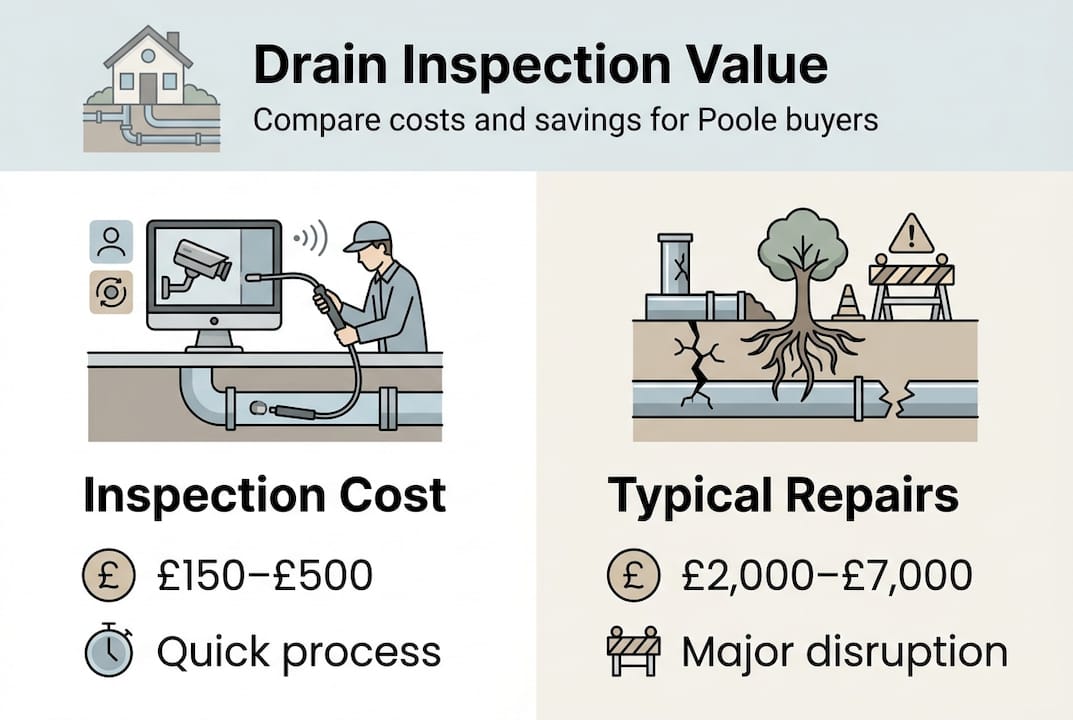
A £150–£500 drain survey can uncover faults that save buyers £5,000 or more, with repairs otherwise costing between £2,000 and £15,000 if discovered after purchase. The maths is straightforward. Spending £300 on a survey that reveals a £6,000 pipe collapse means you either negotiate that off the price or avoid the property altogether. Either way, you are thousands of pounds better off.
| Scenario | Survey cost | Fault found | Negotiation saving | Net saving |
|---|---|---|---|---|
| Root ingress, clay pipe | £250 | £3,500 repair | £3,000 price reduction | £2,750 |
| Collapsed section | £350 | £9,000 repair | £7,500 price reduction | £7,150 |
| No fault found | £200 | None | Peace of mind | Invaluable |
| Blockage only | £200 | £400 repair | £400 or seller fixes | £200 |
Here is the sequence most buyers use to turn survey results into negotiation leverage:
- Receive the written CCTV report with graded defects and repair estimates
- Obtain at least one independent repair quote from a qualified drainage contractor
- Present the report and quote to the seller or their agent formally in writing
- Request either a price reduction equal to the repair cost or that the seller arranges repairs before completion
- If the seller refuses and the fault is severe, consider withdrawing before exchange
The CCTV survey benefits extend beyond the immediate transaction. A clean survey report can also support your home insurance application, as insurers increasingly ask about drainage condition. Properties with documented, healthy drainage systems are easier to sell in the future and less likely to attract down-valuations from mortgage lenders. The drain survey process is a one-off cost that protects a long-term asset.
Key figure: Buyers who discover faults through pre-purchase surveys save an average of £3,800 per transaction, based on typical Poole repair costs and negotiation outcomes.
When should you book an inspection? Myths versus smart practice
The maths is compelling, but what about those common assumptions? When is an inspection actually essential, and when can you skip it?
The biggest myth is that drain surveys are only for old or obviously run-down properties. In reality, drain inspections are essential for older properties, properties with trees nearby, or where damp or odours are present, but the list does not stop there. Flats, new builds, and recently renovated homes all carry their own risks. Renovation work frequently damages underground pipes through accidental impact or incorrect reconnection.
Book a pre-purchase drain inspection if any of the following apply:
- The property was built before 1980
- There are mature trees within 10 metres of the building
- You can smell drains inside or near the property
- There is visible damp in the ground floor or basement
- The property has a history of blocked drains or slow-draining sinks
- The garden shows unexplained wet patches or subsidence
- The property is in a coastal or clay-heavy area like much of Poole
Pro Tip: Book your drain inspection at the same time as your structural survey, not after. This way, both sets of results arrive before you are committed to exchange, giving you maximum time to negotiate or reconsider. Drainage inspections in Dorset are best arranged as early as possible in the buying process.
Once results arrive, you have three clear options: proceed with confidence, negotiate on price or repairs, or withdraw. Modern drain surveys are fast, typically completed within a few hours, and reports are usually issued within 24 to 48 hours. There is no reason to delay. A drain camera explained simply is a tool that removes guesswork from one of the most financially significant decisions of your life.
The uncomfortable truth: why skipping a drain inspection is a gamble
Now, let’s look at the real-world implications of taking shortcuts.
In our experience working across Poole and Dorset, property surveys gloss over drainage far more often than buyers realise. A structural surveyor is not a drainage engineer. They note what they can see. Underground pipes are invisible to them, and most surveyors will simply recommend a specialist inspection if they suspect a problem. That recommendation is easy to ignore when you are eager to complete.
Buyers who skip drain inspections and later discover faults almost always say the same thing: they wish they had spent the £200 to £300. The regret is not just financial. It is the disruption of excavation works, the stress of negotiating with a seller who has already moved on, and the realisation that the problem was entirely avoidable. In Poole specifically, coastal soils and high tree cover make hidden drainage faults more common than in many other parts of the country. The full inspection process is straightforward and the cost is modest relative to the risk. Skipping it is not a saving. It is a gamble with your biggest investment.
Book your drain inspection for total peace of mind
For anyone ready to avoid these headaches, here is how you can get immediate help.
At Blocked Drains Poole, we carry out pre-purchase drain inspections across Poole and the wider Dorset area, with no call-out fees and fast turnaround on written reports. Our local knowledge of Poole’s drainage infrastructure means we know exactly where to look and what to expect from different property types and areas.

Whether you are buying a Victorian terrace in the Old Town or a modern flat in Canford Cliffs, our drainage inspection for Poole homes gives you the evidence you need before you commit. We also offer guidance on safeguarding Dorset homes from long-term drainage risks. Get in touch today for a no-obligation quote and protect your investment from day one.
Frequently asked questions
Are pre-purchase drain inspections legally required in Poole?
No, they are not legally required but are strongly recommended for older properties, homes near trees, or where damp or odours are present. Most solicitors and mortgage advisers consider them essential due diligence.
How much does a pre-purchase drain inspection typically cost?
Expect to pay between £150 and £500 for a drain survey in Poole, with the final price depending on property size, access, and the number of drainage runs to be checked.
Can a drain issue lower the property’s value?
Yes. Undetected drain faults can reduce property value by 5–15% and make a sale significantly harder to complete, particularly if faults emerge during a buyer’s own survey.
What happens if a fault is discovered during the inspection?
You can use the report to negotiate £1,200 to £5,000 off the asking price, request the seller arranges repairs before completion, or withdraw from the purchase entirely before exchange.
Recommended
- How to inspect drains when buying a home: step-by-step
- Drainage Inspection: Why Poole Homes Need It
- Drain Survey Explained – Protecting Your Poole Home
- Why drains need regular inspection to avoid costly repairs
- Why timely drain repairs protect properties and cut costs
- Buying a Home in the GTA? Get a Plumbing Inspection First. Here Is Why. | Proper Plumbing GTA Blog