
Blocked drains can turn a peaceful Poole home into a constant source of stress, especially when the same pipe keeps causing trouble. Understanding exactly where your responsibility ends and the water company’s begins is crucial for avoiding costly disputes. A professional drainage inspection uncovers hidden faults, clarifies legal obligations, and stops the guesswork behind endless repairs, helping you protect both your property and your peace of mind.
Table of Contents
- What Drainage Inspection Involves
- Types of Drainage Inspection Methods
- Legal Compliance for UK Drainage
- Responsibilities of Owners and Professionals
- Risks of Neglecting Drainage Inspection
- Drainage Inspection Versus Alternatives
Key Takeaways
| Point | Details |
|---|---|
| Comprehensive Drainage Inspection | A thorough drainage inspection identifies ownership boundaries, maintenance responsibilities, and underlying issues, ensuring informed repair decisions for homeowners. |
| Inspection Methods | Various methods, including CCTV surveys and visual inspections, provide detailed insights into drainage conditions, helping diagnose and resolve recurrent blockages effectively. |
| Legal Obligations | Homeowners must understand their legal responsibilities regarding private drains and comply with Building Regulations to prevent disputes and ensure safety. |
| Risks of Neglect | Delaying drainage inspection can lead to severe blockages, structural damage, and legal liabilities, which are often far more costly than regular maintenance. |
What Drainage Inspection Involves
Drainage inspection is far more than simply poking a camera down your pipes and hoping for the best. It’s a systematic assessment of your entire drainage system to identify what’s working, what’s failing, and crucially, where your actual responsibility ends and your water company’s begins. For Poole homeowners, this distinction matters enormously because private drains inside your property are entirely your responsibility, whilst lateral drains beyond your boundary typically fall to the local sewerage company. A proper inspection establishes exactly which parts of your drainage network you own and must maintain.
The technical side of inspection covers several distinct areas. An inspection examines your sanitary pipework, foul water drainage systems, and rainwater drainage to assess the overall condition and identify potential issues. The surveyor looks at the materials used (is it old clay, modern PVC, or something in between?), the workmanship of any previous repairs, the layout and gradient of pipes, and any blockages that might be forming. They’re also checking for air tightness within the system, which prevents unpleasant odours and maintains proper drainage function. When your drains are repeatedly blocking or draining sluggishly, inspection reveals whether the problem stems from tree roots penetrating old pipework, accumulated grease buildup, structural collapses, or poor pipe gradients. Understanding what drainage systems require in terms of inspection and testing ensures you know exactly what a comprehensive survey should cover.
What makes inspection particularly valuable for recurring blockage problems is that it moves you from guesswork to certainty. Instead of repeatedly calling out drain cleaners to clear the same section, you discover the root cause. Is it consistently the same location? That suggests structural damage. Does it happen after heavy rainfall? That points to inadequate rainwater drainage capacity or infiltration. Does it worsen seasonally? Tree roots. Once you understand what’s actually happening beneath your property, you can make informed decisions about whether repairs, relining, or simple maintenance will solve the problem. For Poole’s older housing stock with Victorian and Edwardian drainage infrastructure, this knowledge becomes invaluable for protecting your investment and avoiding repeated emergency call-outs.
Pro tip: Request a full CCTV survey report with still photographs and footage showing problem areas; this documentation proves invaluable if you need to claim on insurance, negotiate with neighbours about shared drains, or plan future repairs with certainty rather than assumptions.
Types of Drainage Inspection Methods
When you ring a drain specialist about your blockage problems, you might hear several technical terms thrown around. Not all inspection methods are created equal, and understanding what each one reveals is crucial for getting the right diagnosis. The method chosen depends on what you’re trying to discover, how accessible your drains are, and what’s causing the recurring issues in your Poole home.
Visual inspection forms the foundation of any drainage assessment. This involves physically examining accessible areas like manholes, gullies, and external inspection chambers where a surveyor can look directly into the system. For older properties with surface-level access points, this method reveals obvious problems straightaway: accumulated debris, structural damage, root ingress at joints, or sediment buildup. However, visual inspection alone cannot see inside your buried pipework where the real problems often hide.
CCTV surveys (closed-circuit television) are the workhorse of modern drainage diagnosis. A small waterproof camera on a flexible rod travels through your pipes, transmitting live footage to the surveyor above ground. This method provides detailed internal views of pipe conditions, revealing cracks, joint misalignments, collapsed sections, tree root intrusion, and blockage locations with pinpoint accuracy. For Poole’s Victorian and Edwardian drainage systems, CCTV surveys are invaluable because they show exactly where old clay pipes have fractured or where roots have penetrated without requiring extensive excavation.
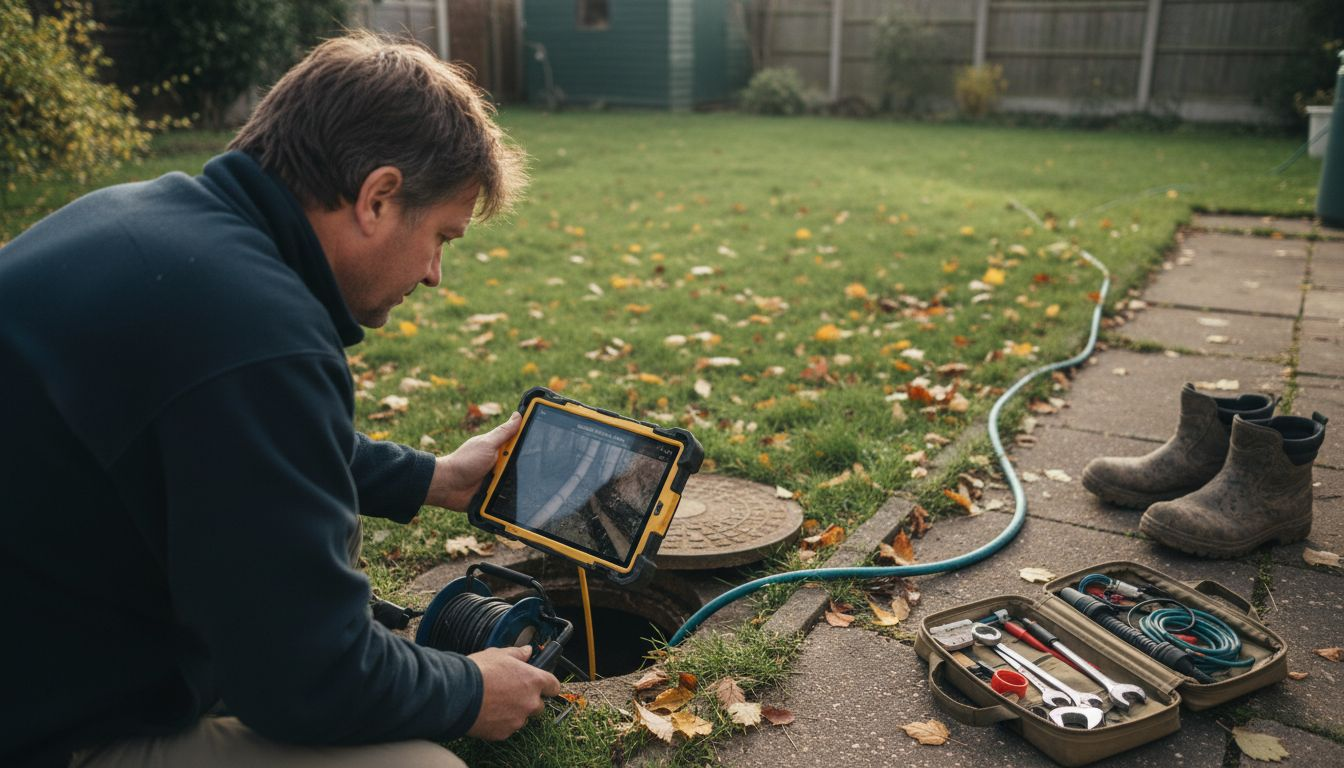
Beyond these common methods, inspection techniques include smoke testing and pressure testing for specific problems. Smoke testing forces harmless smoke through your drainage system to identify illegal connections or pinpoint where leaks occur, particularly useful when you suspect infiltration from groundwater. Pressure testing verifies the structural integrity of pipes by applying controlled pressure and measuring for leaks, ensuring joints are sound and the system can handle normal flow rates without failure. These specialised methods address particular concerns rather than providing general system health checks.
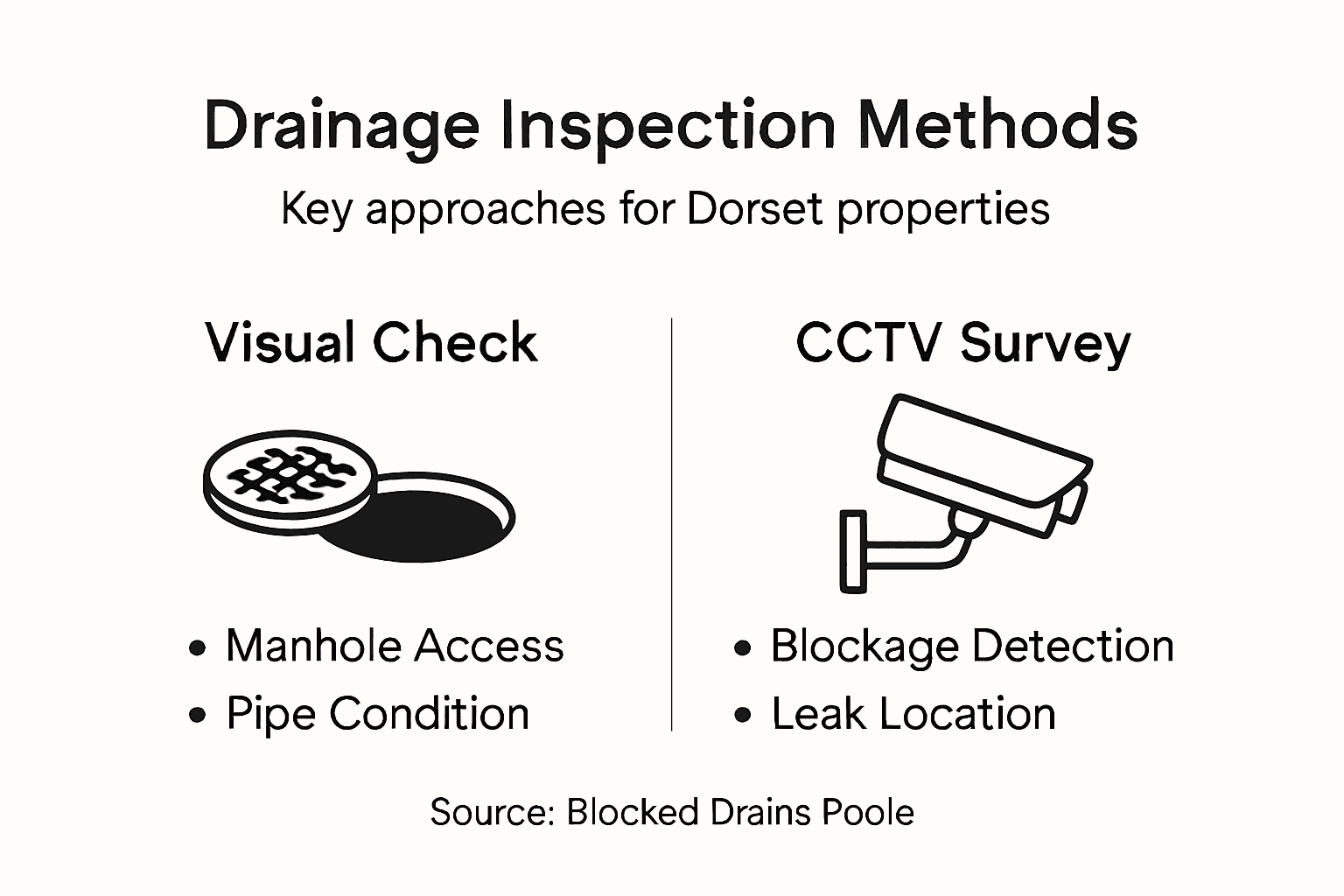
For recurring blockage issues in Poole, the combination of CCTV survey and visual inspection typically provides complete clarity. CCTV shows you what’s happening inside the pipes, whilst visual inspection of accessible points confirms whether problems extend into connected systems. Testing protocols assess pipe integrity, joint stability, and overall capacity to ensure your drainage operates correctly under normal conditions. Once you know exactly what’s wrong, you can proceed with confidence toward repair solutions rather than temporary fixes.
Pro tip: Always request a full CCTV survey report with clear footage and still images showing problem areas at specific pipe depths and distances from your property; this documentation becomes essential reference material for future maintenance and proves invaluable when discussing solutions with repair specialists.
Here’s a comparison of drainage inspection methods and what each reveals:
| Method | Reveals | Typical Use in Poole |
|---|---|---|
| Visual Inspection | Surface debris, clear access | Quick assessment of chambers |
| CCTV Survey | Internal pipe condition | Detailed diagnosis of old pipes |
| Smoke Testing | Hidden leaks, illegal links | Locating infiltration problems |
| Pressure Testing | Structural pipe strength | Checking for joint failures |
Legal Compliance for UK Drainage
Drainage law in the UK isn’t something most homeowners think about until something goes wrong. But understanding your legal obligations matters enormously, particularly in Poole where older properties often have shared drainage arrangements and unclear responsibility boundaries. The legal framework governing UK drainage stems from building regulations and local authority requirements, creating clear rules about who maintains what and when compliance becomes mandatory.
The fundamental legal distinction centres on private drains versus public sewers. Private drains inside your property boundary remain entirely your responsibility for maintenance and repair, regardless of their condition or age. This means if tree roots crack your Victorian clay pipes, blockages form repeatedly, or structural damage occurs, you’re legally responsible for fixing it. Lateral drains that extend beyond your property boundary but connect to the public sewer fall into a grey area where the water company typically maintains them, though your property deed might specify different arrangements. Public sewers, once your drainage connects to them, are maintained by the water authority at no cost to you. Understanding which category applies to your Poole home prevents costly disputes and ensures you’re not paying for repairs that legally belong to the utility company.
Building Regulations Approved Document H governs the technical and legal standards for all UK drainage systems. Approved Document H covers foul water drainage, rainwater management, and required testing standards to prevent pollution and protect public health. When you repair, alter, or install new drainage connections, you must comply with these regulations or face enforcement action from local authorities. This covers everything from pipe materials and gradients to access points and testing requirements. Even seemingly simple repairs like replacing damaged sections of pipework technically require building regulation approval in many cases, though emergency repairs to restore basic function are often treated more leniently. Local authorities have legal powers to examine, test, and require repairs to private and public drainage systems, meaning inspectors can demand corrective work if your system fails to meet standards.
For Poole homeowners with recurring blockage issues, legal compliance intersects directly with practical maintenance. Ignoring drainage problems isn’t just inconvenient; it can breach building regulations if the system fails to function safely and without pollution risk. Regular inspection demonstrates due diligence and identifies problems before they escalate into regulatory violations. When you finally do need repairs, ensuring the contractor follows Building Regulations protects your property legally and prevents future complications when selling or obtaining insurance.
Pro tip: Always request written confirmation from your contractor that any drainage repairs comply with Building Regulations Approved Document H, and keep this documentation alongside your property records; this proves compliance if local authorities ever inspect or if you need to sell your home.
Responsibilities of Owners and Professionals
When your drains fail, the question of who does what becomes critical. Responsibility splits clearly between property owners and the professionals they engage, but understanding this division prevents confusion, delays, and disputes. Your role as a homeowner differs fundamentally from the obligations placed on drainage contractors and surveyors, yet both must work together within strict legal frameworks to resolve problems safely and compliantly.
Your responsibilities as a property owner are straightforward but demanding. You are responsible for maintaining drains within your property boundaries, ensuring they remain clear and functioning properly. This means you must arrange inspections when blockages recur, contact professionals when structural issues emerge, and fund repairs that fall within your legal ownership. You cannot simply ignore a blockage and hope it resolves itself; the law requires you to ensure your system operates without creating a health or environmental hazard. For Poole properties with older drainage infrastructure, this responsibility becomes more significant because Victorian and Edwardian pipework requires proactive management. You’re also accountable for ensuring any repair work undertaken on your property complies with Building Regulations, which means vetting contractors carefully and verifying their competence before hiring them.
Professional responsibilities are equally rigorous and legally binding. Certified surveyors and drainage contractors must possess proper qualifications and insurance before touching your system. When they arrive at your property, professionals have legal duties under health and safety laws including the Health and Safety at Work Act 1974 and Construction Design and Management Regulations 2015. This means they must assess risks properly, plan work for safe execution, provide appropriate safety measures, and ensure their operating protocols reduce dangers to workers, your household, and the environment. A reputable drainage contractor doesn’t just clear your blockage; they examine the cause, explain findings clearly, recommend appropriate solutions, and execute repairs to Building Regulations standards. They carry liability insurance protecting you if something goes wrong during their work. They maintain competence through training and stay current with legal requirements affecting drainage work.
The partnership between owner and professional works best when expectations align from the start. You provide accurate information about the problem, access to your property, and clear communication about your concerns. Professionals deliver transparent pricing, honest assessments, and work quality that lasts. When hiring drainage contractors in Poole, verify they understand Building Regulations compliance, possess appropriate insurance, and can provide references from similar properties. This collaboration ensures your recurring blockage problem receives proper diagnosis and effective, legal repair solutions rather than temporary fixes that breach regulations or fail within months.
Pro tip: Before engaging any drainage professional, request their Building Regulations compliance certification, public liability insurance details, and references from similar drainage work; this confirms they understand their legal obligations and protects you from paying for substandard work that creates future liability.
Risks of Neglecting Drainage Inspection
It’s tempting to ignore your drains when they’re working. Out of sight, out of mind, as they say. But neglecting drainage inspection transforms a manageable problem into a financial and health nightmare. For Poole homeowners facing recurring blockages, postponing inspection doesn’t make the problem disappear; it compounds, spreading damage deeper into your property infrastructure and creating cascading failures that cost exponentially more to fix than early intervention would have.
The immediate consequences of skipping inspection are visible and disruptive. Without regular assessment, blockages worsen as debris, grease, and sediment accumulate. What started as slow draining becomes complete stoppage. Neglecting drainage inspection can lead to blockages, surcharging, foul water leaks, and structural damage to pipes and buildings. A simple blockage cleared promptly costs perhaps £150 to £300. But when you ignore it, pressure builds inside pipes, forcing sewage backwards into your property. This creates foul water leaks into your garden, seeping into foundations and causing damp inside your home. Structural damage occurs as pipes crack under pressure or collapse entirely. What could have been identified and fixed through inspection now requires excavation, pipe replacement, and potentially underpinning of building foundations. These repairs routinely cost £3,000 to £8,000 or more, depending on how extensively damage has spread before discovery.
The environmental and legal consequences are equally serious. Sewage leaks contaminate soil and groundwater, harming local ecosystems and watercourses. Flooding occurs when your system surcharges, backing up into neighbouring properties and creating liability for damages. Failure to conduct regular drainage inspections increases risks of system failures such as sewage blockages, flooding, surface water contamination, and environmental pollution, which may lead to legal liabilities for property owners. Local authorities can issue enforcement notices requiring you to fix environmental breaches, and if you fail to comply, fines escalate rapidly. Neighbours affected by your sewage overflow can pursue legal action for property damage. Insurance claims become problematic because insurers expect homeowners to maintain their drainage systems; ignoring obvious problems can lead to claim rejections.
For Poole properties with Victorian and Edwardian pipework, neglect accelerates deterioration. Older clay pipes deteriorate gradually, but without inspection you won’t know when they’ve crossed the threshold from aging into dangerous failure. Regular inspection catches these problems at the point where relining or targeted repair prevents catastrophic collapse. The cumulative financial, legal, and health consequences of postponing inspection far exceed the modest cost of a professional CCTV survey and maintenance plan.
Pro tip: Schedule drainage inspection every two years if you haven’t experienced problems, or immediately if blockages recur; this preventative approach catches issues whilst repairs remain affordable and manageable rather than waiting for emergency failure to force expensive excavation.
Here’s a summary of risks associated with neglecting regular drainage inspection:
| Risk Type | Immediate Impact | Long-Term Consequence |
|---|---|---|
| Blockages | Slow draining, backups | Full stoppage, expensive repairs |
| Structural Damage | Cracked pipes, foundation damp | Collapsed pipework, underpinning |
| Pollution | Local water contamination | Environmental fines, legal issues |
| Insurance Claims | Repair costs rise | Claims rejected, loss of cover |
Drainage Inspection Versus Alternatives
When faced with recurring drainage problems, some Poole homeowners wonder whether traditional inspection methods are the only solution. Could you simply redesign your drainage system? Install modern alternatives? Skip inspection altogether and rely on reactive repairs? Understanding what inspection actually does compared to alternative approaches clarifies why inspection remains essential rather than optional for properties with existing drainage infrastructure.
Traditional drainage inspection is diagnostic. It examines your current system to identify what’s wrong, where problems originate, and what repairs will actually resolve them. For properties already built with established drainage networks, inspection answers the critical questions: Is this clay pipe cracked? Where exactly is the blockage occurring? Are roots penetrating joints? Has the pipe collapsed? Once you know these answers, you can plan targeted repairs that address root causes rather than repeatedly clearing the same blockage. Inspection transforms you from guessing to knowing, which makes every subsequent decision more cost effective.
Sustainable Drainage Systems (SuDS) represent an alternative approach gaining traction in new construction and property redesigns. SuDS provide alternative drainage management by incorporating design features that reduce runoff and pollution, improving resilience to flooding and environmental benefits. Rather than relying entirely on underground piped systems, SuDS use green infrastructure including permeable surfaces, rain gardens, detention basins, and vegetation to manage water naturally on site. They reduce the volume of water entering conventional drainage systems, thereby decreasing blockage risk and flooding. However, SuDS work best in new construction or major property renovation where you can redesign site drainage from scratch. For an existing Poole home facing immediate blockage problems, SuDS cannot solve your current crisis because your Victorian or Edwardian piping is already installed. Installing SuDS would complement but not replace inspection and maintenance of your existing underground drainage.
SuDS use vegetation, infiltration, detention, and filtration to reduce the dependency on conventional maintenance and long term inspection costs. This makes SuDS attractive for preventing future problems on properties where you’re willing to invest in landscape redesign. Yet even properties with excellent SuDS still require periodic inspection of any remaining underground drainage to catch structural failures or unexpected blockages. Inspection remains the foundational diagnostic tool because it answers the question all repair decisions depend upon: What is actually happening beneath your property?
The practical reality for Poole homeowners is that inspection and alternatives serve different purposes. Inspection solves your immediate recurring blockage problem by identifying its cause and guiding effective repair. SuDS or other green infrastructure improvements address long term risk reduction and environmental benefits, but cannot replace the diagnostic value of inspection. Most properties benefit from combining both: first using inspection to resolve current issues, then considering drainage system improvements that reduce future maintenance burdens.
Pro tip: If you’re planning major garden landscaping or property renovation, discuss SuDS possibilities with your drainage contractor during inspection; they can advise whether integrated green drainage would complement your existing piped system and reduce future blockage risk.
Protect Your Dorset Home with Expert Drainage Inspection and Repair
Recurring blockages and ageing drainage systems are more than an inconvenience for Poole homeowners They pose serious risks such as structural damage, pollution, and costly repairs as highlighted in the article Drainage inspection reveals root causes like root ingress or pipe corrosion and ensures your private drains function safely and legally Keeping historic Victorian and Edwardian pipework in good condition requires specialised knowledge and prompt action
At Blocked Drains Poole, we combine local expertise with advanced techniques like CCTV surveys and relining to diagnose and fix drainage problems comprehensively Our team understands the legal requirements covered by Building Regulations Approved Document H and the importance of thorough inspections to prevent repeated emergencies You deserve reliable, transparent service without call-out fees and with rapid 24/7 support so your drainage issues never escalate uncontrollably
Act now to save your home from expensive damage and hazardous blockages

Discover how our professional drainage inspection and repair services deliver peace of mind for Dorset residents Contact us today at Blocked Drains Poole to book your CCTV survey or emergency unblock and ensure your drainage system is protected for years to come. Don’t wait until a small issue becomes a costly disaster – get expert help now.
Frequently Asked Questions
What is involved in a drainage inspection?
Drainage inspection is a systematic assessment of your entire drainage system, including sanitary and foul water drainage, to identify issues like blockages or structural failures. It often involves methods like visual inspections and CCTV surveys to provide detailed insights into pipe conditions.
Why is regular drainage inspection important for homeowners?
Regular drainage inspection is crucial as it helps identify underlying problems before they escalate into costly repairs. Ignoring inspections can lead to blockages, structural damage, and environmental issues, ultimately resulting in higher expenses and potential legal liabilities.
How can drainage inspections prevent costly repairs?
Drainage inspections allow homeowners to pinpoint the root causes of recurring blockages instead of just treating the symptoms. By understanding issues like tree root intrusion or aging pipework, informed decisions can be made about targeted repairs, preventing extensive damage and expenses in the future.
What methods are used during drainage inspections?
Common methods during drainage inspections include visual inspections of accessible areas like manholes and gullies, as well as CCTV surveys that use cameras to provide detailed views of the inside of pipes. Additional methods like smoke testing and pressure testing may be used for specific problems.