
Not all drain services are equal, and in Poole, choosing the wrong provider can turn a minor blockage into a costly structural failure. Poole’s drainage network is genuinely unlike most UK towns, built on layers of Victorian clay pipes, pitch fibre, and in some areas, medieval shared drains that predate modern plumbing standards entirely. A national call centre sending out a generic engineer simply won’t know that harbour sand regularly infiltrates central Poole’s systems, or that tree roots are a persistent menace in Parkstone and Oakdale. As specialists with in-depth knowledge of Poole’s ageing infrastructure, we’ve seen first-hand what happens when the wrong approach meets the wrong pipe.
Table of Contents
- Why Poole’s drainage challenges demand local expertise
- Methods and technology used by local drain specialists
- Local specialists vs national chains: What’s the real difference?
- Practical benefits: What you gain by choosing local
- Get reliable, specialist drainage support in Poole
- Frequently asked questions
Key Takeaways
| Point | Details |
|---|---|
| Local knowledge matters | Local drain specialists understand Poole’s unique infrastructure and can tailor repairs to long-standing issues. |
| Better technology, safer fixes | Modern methods like CCTV surveys and no-dig repairs offer lasting solutions with minimal disruption. |
| Quicker, cost-effective service | Choosing a local expert means faster response times, lower costs, and protection of your property’s value. |
| Avoid risky DIY methods | Chemical unblockers and general fixes often harm old pipes—local specialists use safe, proven techniques. |
Why Poole’s drainage challenges demand local expertise
Poole is one of the most historically layered towns on the south coast, and its drainage reflects that complexity. Beneath the streets you’ll find a patchwork of materials and eras that no single generic solution can address reliably. Understanding what’s actually down there is the first step to fixing it properly.
The types of infrastructure local engineers regularly encounter include:
- Victorian clay pipes that are brittle, prone to cracking, and highly sensitive to chemical treatments
- Pitch fibre pipes installed widely in the 1950s and 60s, which deform over time and collapse inward
- Medieval shared drains in older parts of the town centre, where ownership and responsibility can be unclear
- Harbour-influenced systems in central Poole, where fine sand regularly infiltrates joints and causes slow-building blockages
- Tree root ingress particularly in Parkstone and Oakdale, where mature street trees send roots into ageing pipe joints
- Silt build-up in Hamworthy, driven by the area’s proximity to tidal water and low-gradient drainage runs
National chains often apply a one-size-fits-all approach: rod it, jet it, move on. That works fine for a straightforward fat blockage in a modern plastic pipe. It does not work for a deformed pitch fibre run that will simply collapse further under high-pressure jetting, or a shared medieval drain where the wrong intervention triggers a neighbour dispute and a structural survey. These are the common drainage problems in Poole that local engineers are trained to recognise immediately.
Local specialists possess in-depth knowledge of Poole’s ageing infrastructure, including Victorian clay pipes, pitch fibre, medieval shared drains, and harbour-influenced systems, which gives them a decisive advantage in diagnosing problems accurately the first time.
The cost of ignoring a blockage: Industry data consistently shows that unresolved drainage issues escalate rapidly. What starts as a slow drain can become a collapsed pipe, a flooded property, or a contaminated soakaway within months. Repair costs multiply accordingly, and insurance claims become far more complicated once structural damage is involved.
With the context set, it’s worth looking deeper at the technical approaches that local specialists actually use.
Methods and technology used by local drain specialists
The tools and techniques a local Poole engineer brings to a job are specifically chosen for the infrastructure they’re likely to encounter. This isn’t just about having the right equipment; it’s about knowing which method is appropriate for which pipe material, age, and condition.
Methodologies include high-pressure water jetting, CCTV surveys, drain rodding, root cutting, no-dig relining, and soakaway installations, each selected based on what the diagnostic stage reveals.
| Problem type | Recommended method | Why it suits Poole’s infrastructure |
|---|---|---|
| Tree root ingress | Root cutting and jetting | Precise removal without damaging brittle clay joints |
| Fatberg or grease blockage | High-pressure water jetting | Clears build-up without chemical corrosion risk |
| Collapsed or deformed pipe | No-dig relining | Restores flow without excavation in older streets |
| Sand or silt accumulation | Jetting and CCTV survey | Identifies source and clears without over-pressurising |
| Cracked Victorian clay pipe | CCTV survey then patch lining | Targeted repair rather than full pipe replacement |
A standard job for a local Poole engineer follows a clear sequence:
- Initial assessment by phone to understand symptoms and likely cause
- On-site visual inspection to check access points, pipe age, and surface signs
- CCTV drain surveying to get a precise internal view of the pipe condition
- Diagnosis and method selection based on pipe material and blockage type
- Targeted intervention using the appropriate tool, whether jetting, rodding, or root cutting
- Post-repair CCTV check to confirm the fix and spot any secondary issues
- Written report with footage, findings, and any recommended follow-up
This process of identifying blockages with CCTV is particularly valuable in Poole because it removes guesswork entirely. You know exactly what you’re dealing with before any work begins.
Pro Tip: Never use shop-bought chemical unblockers on older pipes. Caustic soda and sulphuric acid-based products corrode clay and pitch fibre rapidly, turning a partial blockage into a cracked or fully compromised pipe. Modern jetting and mechanical methods are faster, safer, and don’t leave you with a bigger problem than you started with.
No-dig relining deserves special mention here. Rather than excavating a collapsed or cracked pipe, engineers insert a resin-impregnated liner that cures in place, effectively creating a new pipe inside the old one. For Poole’s older streets and gardens, this avoids the disruption and cost of digging up Victorian brickwork or mature landscaping.
Once you understand the technical side, the question becomes whether to trust a local firm or a national chain.
Local specialists vs national chains: What’s the real difference?
This is where many homeowners make a costly mistake. A national brand name feels reassuring, but the reality of how those services are delivered often tells a different story.
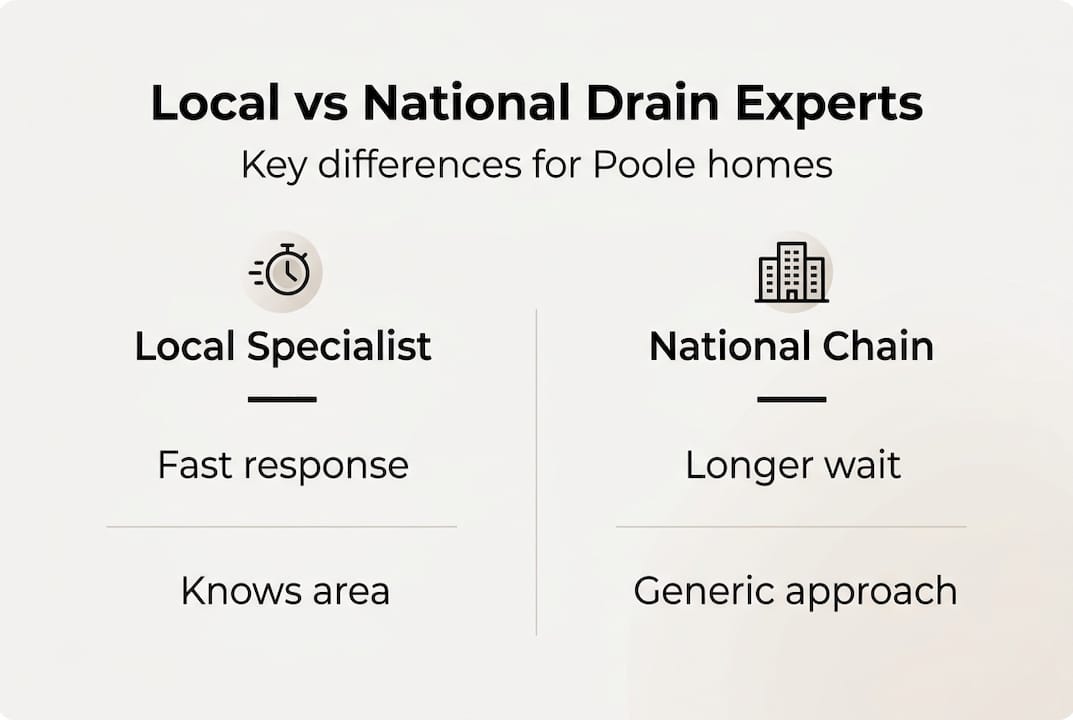
| Factor | Local Poole specialist | National chain |
|---|---|---|
| Response time | Same-day or within hours | Often 24-48 hours via call centre |
| Local infrastructure knowledge | Extensive and specific | Generic, not area-specific |
| Consistency of engineer | Same team, familiar with your property | Variable franchise staff |
| Pricing | Transparent, no call-out fees | Often tiered with hidden charges |
| Accountability | Direct, community-based | Corporate complaints process |
| Outcome for older pipes | Tailored to pipe age and material | Standard approach regardless |
The problems with national call centres go beyond slow response times. Local firms offer personal service, community focus, and consistent quality compared to national chains’ generic approaches, which frequently result in repeat visits, incomplete fixes, and frustrated homeowners.
Specific issues with national providers include:
- Engineers unfamiliar with Poole’s specific pipe materials and local quirks
- Franchise inconsistency, where quality varies dramatically between operatives
- Call centre triage that misdiagnoses problems before anyone arrives on site
- Pressure to upsell unnecessary services rather than apply the most appropriate fix
- Longer wait times that allow blockages to worsen and cause secondary damage
There’s also a financial argument for calling a local specialist promptly. The consequences of blocked drains extend well beyond inconvenience. Unresolved drainage issues can contribute to a 10-15% drop in property value, a figure that makes the cost of a professional local callout look very modest indeed.
Now, let’s look at the practical benefits you’ll enjoy by choosing local, with concrete examples for Poole homeowners.
Practical benefits: What you gain by choosing local
Choosing a local Poole drainage specialist isn’t just about avoiding the pitfalls of national chains. It’s about getting genuinely better outcomes, faster, and at a cost that reflects the actual work required.
Here’s what that looks like in practice for Poole homeowners:
- A slow drain in a 1930s Parkstone terrace is correctly identified as root ingress into a clay lateral, not a simple fat blockage, saving you from repeat jetting visits that never solve the root cause
- A silt-blocked drain in Hamworthy is cleared with targeted jetting at the right pressure for the pipe age, rather than maximum-pressure jetting that risks joint failure
- A shared drain dispute in the old town is handled by an engineer who understands the local ownership rules and can advise on responsibility before any work begins
- A pitch fibre pipe in Oakdale is assessed for deformation before any jetting takes place, preventing a collapse that would require full excavation
- An emergency overflow on a Bank Holiday is attended within hours, not the following working day
Ignored blockages can result in 5-10x higher repair costs and up to a 15% property value drop, which makes regular professional maintenance one of the most cost-effective things a Poole homeowner can do.
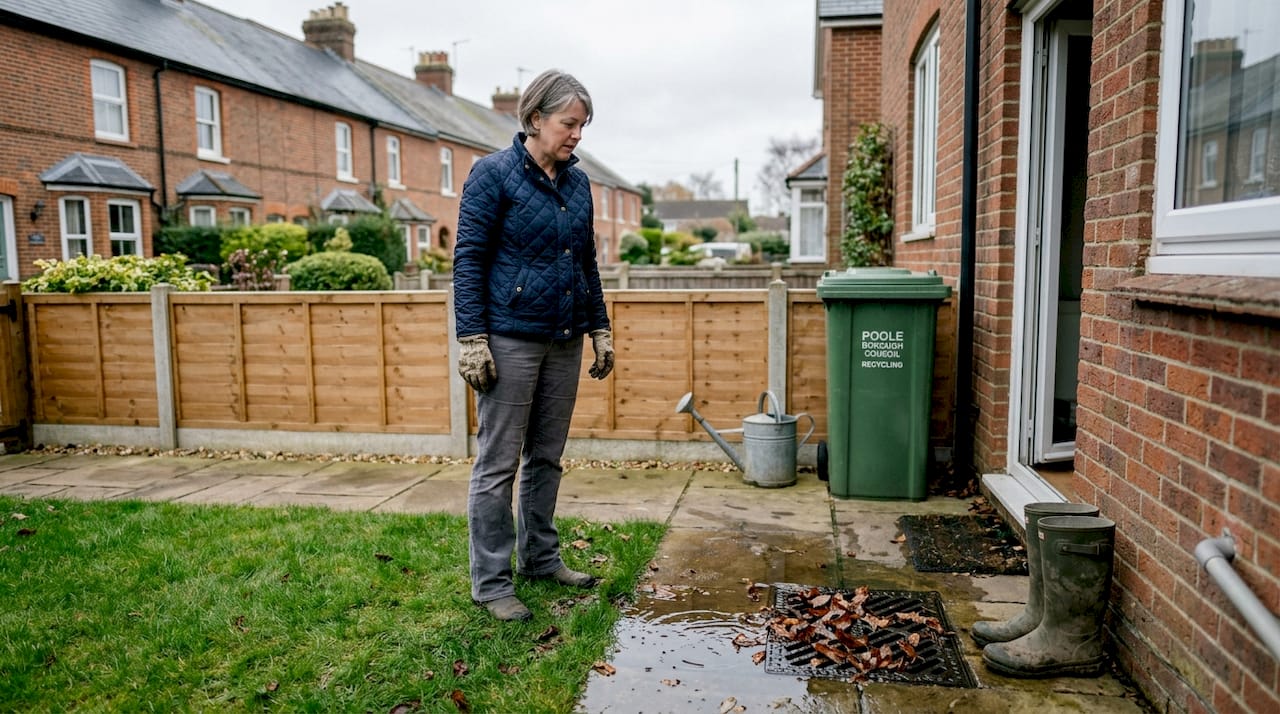
The flooding risks from blocked drains are particularly relevant in Poole given the town’s low-lying areas and proximity to the harbour. A blocked drain during heavy rainfall isn’t just unpleasant; it can result in sewage backing up into your home, which triggers insurance complications and potential health risks.
Pro Tip: Book a local drain inspection every two to three years, especially if your property was built before 1980. Early identification of deforming pitch fibre or cracked clay means you can opt for no-dig relining at a fraction of the cost of emergency excavation. It also keeps your drainage records current, which buyers and surveyors increasingly ask for during property sales.
Smart preventing blockages habits, combined with periodic professional checks, extend pipe life significantly and keep your insurance position clean. Local engineers can also advise on what not to put down your drains based on the specific pipe materials in your property, which is genuinely useful guidance that a generic national helpline simply cannot provide.
Get reliable, specialist drainage support in Poole
If this article has made one thing clear, it’s that Poole’s drainage network rewards local knowledge and punishes generic solutions. The difference between a quick, accurate fix and a repeat-visit nightmare often comes down to whether your engineer actually knows what’s beneath your street.

At Blocked Drains Poole, we offer 24/7 emergency response with no call-out fees, transparent pricing, and engineers who know Poole’s infrastructure from the harbour to the hilltops. Whether you need a straightforward unblock or a full CCTV survey on an older property, we have the tools and the local knowledge to get it right first time. Read our drain unblocking procedure to understand exactly what to expect, or check our safe home unblocking advice if you want to try a simple fix before calling us out. When you’re ready for professional help, we’re ready to respond.
Frequently asked questions
What makes Poole’s drains different from other UK towns?
Poole’s drains are often older, with clay, pitch fibre, and special risks from harbour sand and tree roots, so standard national solutions can miss key faults. Sand ingress from the harbour, tree roots in Parkstone and Oakdale, and silt in Hamworthy all require targeted local knowledge to address properly.
How quickly can a local Poole drain specialist respond?
Local specialists typically respond same-day or within a few hours, which is considerably faster than national call-out centres. Local firms offer faster response than national chains, which matters enormously when a blockage is actively worsening.
Are home remedies or chemical unblockers safe for Poole’s old pipes?
DIY chemical unblockers often corrode ageing clay and pitch fibre pipes, turning a partial blockage into a structural problem. Professional equipment such as mechanical jetting and CCTV is far safer and delivers a permanent fix without pipe damage.
Can a blocked drain affect my property’s value?
Yes, property values can fall 10-15% if serious drainage problems are left unresolved, and repair costs can multiply by five to ten times compared to early intervention.
What modern tools do local specialists use for drain repairs?
Local Poole specialists use CCTV cameras, jetting, root cutting and no-dig relining to diagnose and repair drains without excavating your garden or driveway.