
Poole’s older housing stock and historic drainage infrastructure create a perfect storm for pipe problems. Cracked clay pipes, root ingress from mature trees, and decades of corrosion can turn a minor leak into a costly structural headache almost overnight. If you’ve noticed slow drains, damp patches near foundations, or recurring blockages, your pipes may already be failing. Drain relining offers a modern, proven fix that restores your drainage without tearing up your garden or driveway. This guide walks you through everything: what relining is, how it’s done, and how to decide if it’s right for your Poole property.
Table of Contents
- Understanding drain relining: what it is and why it matters
- What you need before relining: tools, inspection, and prerequisites
- Step-by-step guide: how drain relining is done in Poole
- Relining versus replacement: key differences and choices
- Results to expect: lifespan, performance, and maintenance tips
- Find trusted drain relining services in Poole
- Frequently asked questions
Key Takeaways
| Point | Details |
|---|---|
| Minimal disruption | Relining allows for trenchless repairs, preserving your property and completing jobs fast. |
| Long-lasting results | A properly relined pipe can last over 50 years, offering performance equal to new installations. |
| Cost-effective | Relining typically costs 30-60% less than traditional replacement due to reduced labour and materials. |
| Local suitability | Urban conditions and common pipe issues in Poole make relining a smart choice for most properties. |
Understanding drain relining: what it is and why it matters
Drain relining is not a patch job. It’s a full structural repair carried out entirely from inside the pipe. The CIPP trenchless repair technique works by inserting a resin-saturated flexible liner into the damaged pipe, then curing it in place to form a seamless new pipe within the old one. The result is a smooth, jointless surface that resists root intrusion and corrosion far better than the original pipework.
For Poole homeowners, this matters enormously. Much of the town’s drainage network dates back decades, with clay and cast iron pipes that were never designed to last indefinitely. Relining suits cracks, corrosion, and root intrusion in pipes that still retain their basic shape, and it works across a wide range of materials including clay, cast iron, PVC, and galvanised steel. Understanding the drain relining savings available compared to full replacement helps you make a genuinely informed decision.
Here’s a quick overview of the key benefits:
- No excavation required: your garden, driveway, and landscaping stay intact
- Faster completion: most residential jobs finish within a single day
- Suitable for aged pipework: ideal for Poole’s older clay and cast iron systems
- Long service life: relined pipes perform reliably for decades
- Reduced long-term costs: fewer repeat repairs and no reinstatement bills
| Feature | Drain relining | Traditional repair |
|---|---|---|
| Excavation needed | No | Yes |
| Typical completion time | 1 day | 2 to 5 days |
| Disruption to property | Minimal | Significant |
| Suitable for aged pipes | Yes | Yes |
| Long-term cost | Lower | Higher |
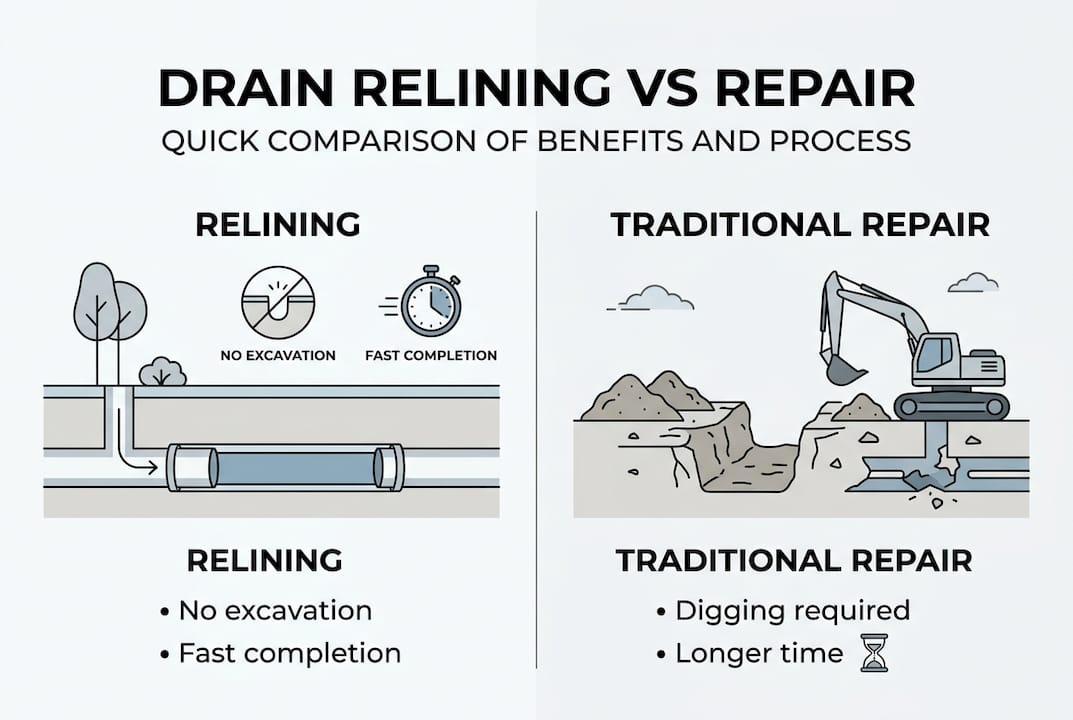
Understanding the importance of drainage repairs early on prevents minor issues from escalating into expensive structural failures.
What you need before relining: tools, inspection, and prerequisites
Before any liner goes into the ground, the pipe must be properly assessed. Rushing this stage is one of the most common mistakes property owners make. A thorough CCTV survey is not optional; it’s the foundation of a successful reline. The camera footage reveals the exact location and nature of damage, confirms the pipe retains enough structural integrity to hold a liner, and rules out conditions like total collapse that would require full replacement instead.
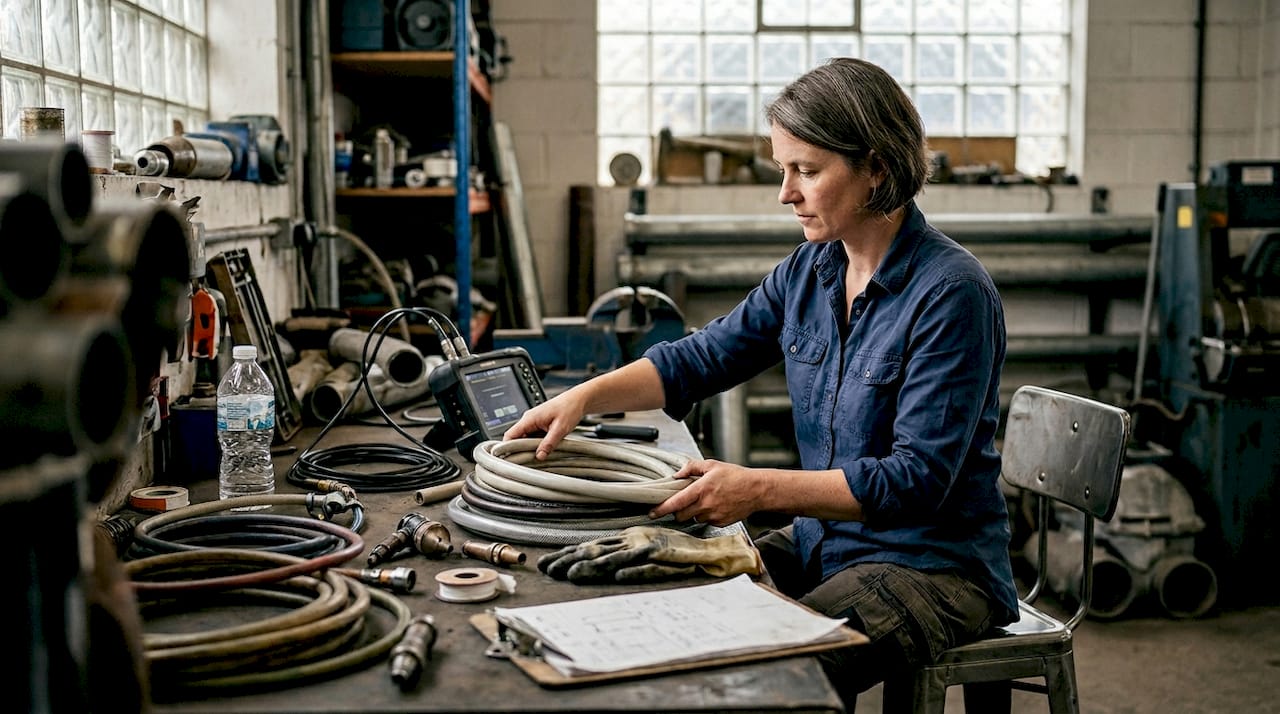
In Poole, CCTV surveys frequently uncover root ingress from the town’s mature street trees, joint displacement in older clay runs, and grease build-up in properties near the harbour. Relining is appropriate for cracks, corrosion, and root intrusion where the pipe still holds its basic form. If the survey shows a pipe has fully collapsed or shifted significantly out of alignment, relining won’t be suitable. The CCTV drain survey benefits extend beyond just confirming relining suitability; they give you a documented record of your drainage system’s condition.
The equipment and materials required for a professional reline include:
- Flexible felt or fibreglass liner saturated with epoxy or polyester resin
- Inflation bladder to press the liner firmly against the pipe wall during curing
- UV or ambient cure system depending on the resin type used
- High-pressure water jetter to clean the pipe thoroughly before lining
- CCTV camera system for pre and post-inspection
Pro Tip: Always insist on a pre-reline CCTV survey from a local Poole specialist. Engineers familiar with the area’s specific pipe ages and soil conditions will spot problems that a generic national contractor might miss. Minimally invasive repair techniques have advanced significantly, but local knowledge still makes a real difference to outcomes.
| Condition | Relining suitable? | Replacement needed? |
|---|---|---|
| Hairline cracks | Yes | No |
| Root intrusion | Yes | No |
| Corrosion | Yes | No |
| Minor joint offset | Yes | Possibly |
| Total pipe collapse | No | Yes |
| Severe misalignment | No | Yes |
Step-by-step guide: how drain relining is done in Poole
Once the survey confirms relining is viable, the process moves quickly. Here’s exactly how it unfolds on a typical Poole residential job:
- High-pressure jetting: The pipe is thoroughly cleaned using a powerful water jetter to remove scale, grease, roots, and debris. A clean surface is essential for the resin to bond properly.
- Pre-reline CCTV check: A second camera pass confirms the pipe is clean and ready. Any remaining obstructions are cleared at this stage.
- Liner preparation: The felt or fibreglass liner is cut to length and saturated with resin. This is done carefully to ensure even coverage throughout.
- Liner insertion: The resin-soaked liner is fed into the pipe using an inversion drum or pull-in method, depending on the pipe’s diameter and access points.
- Inflation and curing: An inflation bladder expands the liner against the pipe wall. Curing takes place via UV light or ambient temperature, typically within one to four hours.
- End trimming and reinstatement: Once cured, the liner ends are trimmed and any lateral connections are reinstated using a robotic cutter.
- Post-reline CCTV inspection: A final camera survey confirms the liner has bonded correctly, with no wrinkles, voids, or missed sections.
The relined pipe lifespan of 50-plus years means this is genuinely a long-term fix, not a temporary measure. Residential projects typically complete in one day, and costs run 30 to 60% less than replacement because there’s no excavation, no reinstatement of surfaces, and no skip hire required.
Pro Tip: Never skip the post-reline CCTV check. It’s the only way to confirm the liner has cured without defects. A reputable Poole contractor will include this as standard. If they don’t offer it, ask why. You can also review non-intrusive repair methods to understand what good practice looks like before booking.
Key stat: Relined pipes can last 50 years or more, and the work is typically completed within a single day for residential properties, at a fraction of the cost of digging out and replacing the pipe entirely.
Relining versus replacement: key differences and choices
Choosing between relining and replacement is not always straightforward. The right answer depends on what the CCTV survey reveals. Here’s a direct comparison to help you think it through:
| Factor | Drain relining | Full replacement |
|---|---|---|
| Cost | 30 to 60% cheaper | Higher, includes reinstatement |
| Disruption | Minimal, no digging | Significant excavation |
| Completion time | Usually 1 day | 2 to 5 days or more |
| Lifespan | 50-plus years | 50-plus years |
| Suitable for collapse | No | Yes |
| Pipe diameter | Reduced by 10 to 15% | Unchanged |
Relining minimises disruption and is faster for suitable cases, but replacement remains the only option when a pipe has fully collapsed or requires a change in gradient. In urban Poole, where properties sit close together and driveways are often block-paved or tarmacked, the cost of excavation and surface reinstatement can easily double the bill for a straightforward replacement job. Relining sidesteps all of that.
That said, relining carries risks if misapplied. Lining a pipe that’s too far gone can result in liner failure within a few years, leaving you back at square one. This is why the pre-reline survey is so critical. Explore the full range of types of drain repairs to understand where relining sits within the broader toolkit, and look at real drainage repair examples from Poole properties to see how decisions are made in practice.
“In densely built areas like central Poole, relining is almost always the preferred first option where the pipe structure allows it. The savings in surface reinstatement alone often justify the choice.”
Results to expect: lifespan, performance, and maintenance tips
Once your drain has been relined, you can expect a significant improvement in flow performance. The smooth internal surface of the cured liner reduces friction and eliminates the rough edges and joint gaps where debris used to catch and accumulate. Blockages become far less frequent.
In terms of longevity, relined pipes typically last 50 years or more, which puts them on a par with brand-new pipework. That’s a meaningful return on investment for any Poole homeowner or property manager. The liner also seals out groundwater infiltration, which is particularly valuable in low-lying parts of Poole where the water table sits close to the surface.
To keep your relined drains performing well, follow these simple maintenance steps:
- Avoid pouring fats and oils down the sink: even with a smooth liner, grease build-up will eventually cause problems
- Use drain guards on external gullies: leaves and debris are a leading cause of blockages in Poole’s older properties
- Flush drains with hot water monthly: a simple habit that keeps the liner surface clear
- Report slow drainage early: catching a partial blockage before it worsens saves money and prevents pressure build-up on the liner
Pro Tip: Book a CCTV inspection every five to ten years even if you’re not experiencing problems. It’s far cheaper to catch a developing issue early than to deal with a failure. Addressing prompt drain repairs before they escalate is the single most cost-effective thing a Poole property owner can do for their drainage system.
Find trusted drain relining services in Poole
You now have a solid understanding of how drain relining works, what it costs, and when it’s the right choice for your property. The next step is finding a local specialist who knows Poole’s drainage infrastructure inside out.

At Blocked Drains Poole, we handle everything from initial CCTV surveys through to full Poole drain relining and post-reline inspections. We offer upfront pricing with no call-out fees, and our team is available 24 hours a day for emergency response. Whether you need a drain unblocking procedure before a reline can take place, or you want to start with a drain CCTV survey to understand the condition of your pipes, we can book you in quickly. Get in touch today for a no-obligation quote and let us take the guesswork out of your drainage repairs.
Frequently asked questions
How long does a relined drain last?
Relined drains typically last 50 years or more, often matching brand-new pipes in durability. This makes relining a genuinely long-term solution rather than a short-term fix.
Does drain relining reduce pipe diameter?
Yes, relining reduces diameter by 10 to 15%, but in most residential pipes this has no noticeable effect on drainage performance or flow capacity.
What types of pipes can be relined?
Cast iron, clay, PVC, and galvanised pipes can all be relined successfully, provided their basic structural shape is still intact and the pipe has not fully collapsed.
Is drain relining disruptive to property owners?
Relining minimises disruption and is typically completed within a single day, with no excavation required, meaning your garden, driveway, and daily routine remain largely undisturbed.