
TL;DR:
- Poole’s old drainage systems are prone to deterioration due to corrosion, root ingress, and structural failure.
- Early signs include slow drainage, foul smells, damp patches, and repeated blockages.
- Modern repair techniques like relining and CCTV surveys offer cost-effective, long-lasting solutions.
Poole’s historic streets and Victorian-era properties are full of character, but beneath the surface lies an ageing drainage network that can quietly become a serious liability. Many homeowners underestimate just how quickly old pipework can deteriorate, especially in a coastal town where saltwater corrosion, ground movement, and decades of accumulated debris all work against even well-built systems. The Baiter Sluice reconstruction cost £1.2 million, a stark reminder of what neglected infrastructure can demand. This guide walks you through identifying, understanding, and properly resolving historic drainage challenges before they spiral into something far more costly.
Table of Contents
- What are historic drainage challenges and why do they matter?
- Spotting the signs: common symptoms of historic drainage problems
- Causes of recurring drainage issues in older Poole properties
- Restoration and modern solutions: professional approaches for lasting repair
- What most homeowners get wrong about historic drainage repairs
- Get professional help for historic drainage challenges in Poole
- Frequently asked questions
Key Takeaways
| Point | Details |
|---|---|
| Old drains have hidden risks | Neglecting historic drainage can result in major costs and property damage. |
| Know the warning signs | Persistent smells, blockages, and dampness often point to underlying drainage issues. |
| Professional solutions last | Modern repair techniques can upgrade old systems without disruptive full replacement. |
| Council vs homeowner roles | You must act quickly on private drains, while public highways are council managed. |
What are historic drainage challenges and why do they matter?
Historic drainage challenges refer to problems rooted in pipework and drainage layouts that were installed decades ago, often using materials and methods that simply were not built to last indefinitely. In Poole, many properties still rely on original clay or pitch-fibre pipes laid during the Victorian period or mid-twentieth century. These systems were designed for a different era of household water use and have long since passed their intended lifespan.
The most common issues include:
- Corrosion and cracking in clay or iron pipes exposed to acidic soils or saltwater
- Root ingress, where tree roots exploit tiny joints and cracks, widening them over time
- Pipe collapse, particularly in older sections with no structural reinforcement
- Grease and fat accumulation that hardens into blockages in narrow, unlined pipes
- Outdated drainage layouts that no longer match modern household demands
Understanding why drains get blocked in older systems is essential, because the root cause is rarely just what went down the sink. It is almost always a combination of material degradation and years of gradual build-up.
Why does this matter so urgently? Because historic drainage failures rarely announce themselves dramatically. Instead, they worsen gradually until a minor nuisance becomes a structural emergency. The common causes of blocked drains in older Poole properties often trace back to infrastructure that was already compromised years before the first visible symptom appeared.
The financial stakes are real. Saltwater corrosion led to a major public infrastructure rebuild in Poole, demonstrating that even well-maintained public systems are not immune to the pressures of age and environment. For private homeowners, the costs of a full drain replacement can easily run into thousands of pounds, particularly when excavation is required in tight, built-up areas.
Key insight: Historic drainage problems are rarely isolated. One failing section of pipe almost always signals wider deterioration throughout the system.
Addressing these issues early, with the right professional guidance, is consistently the most cost-effective approach available to Poole homeowners.
Spotting the signs: common symptoms of historic drainage problems
Knowing what to look for is the first practical step in protecting your property. Historic drainage problems produce a recognisable set of warning signs, and catching them early can save you from far more disruptive and expensive repairs later.
Here are the key symptoms to watch for, in order of urgency:
- Slow drainage in sinks, baths, or toilets that does not clear with basic unblocking
- Persistent foul smells around drains, inside or outside the property
- Damp patches on walls, floors, or ceilings near drainage routes
- Repeated blockages that return within weeks of being cleared
- Gurgling sounds from pipes when water drains elsewhere in the property
- Sunken or soft ground near drain runs in the garden, indicating possible collapse
Distinguishing historic problems from ordinary wear is important. A single blockage cleared without recurrence is usually routine. But if the same drain blocks three times in a year, or if you notice damp appearing near a drain run, that points to something structural rather than superficial.
Understanding why blocked drains matter goes beyond inconvenience. Persistent drainage failure can compromise foundations, encourage damp and mould, and even affect property valuations when you come to sell.
It is also worth clarifying responsibility. Homeowners are responsible for drains within property boundaries, while BCP Council handles public highway gullies. Many Poole residents waste time waiting for council action on drains that are actually their own responsibility, which only delays resolution and allows problems to worsen.
“If you are unsure whether a drain is private or public, a professional CCTV survey will clarify the boundary and give you documented evidence of the pipe’s condition.”
Pro Tip: Schedule a visual inspection of your external drain covers every spring. Look for cracks, subsidence around the cover, or any signs of overflow staining. Catching these early costs nothing compared to emergency call-outs.
Do not wait for a complete blockage before investigating. The signs above are your early warning system, and acting on them promptly is the smartest thing you can do as a property owner.
Causes of recurring drainage issues in older Poole properties
Once you have spotted the symptoms, the next question is always: what is actually causing this? Recurring drainage problems in older Poole properties almost always trace back to a handful of underlying causes that are specific to aged infrastructure.
The most significant causes include:
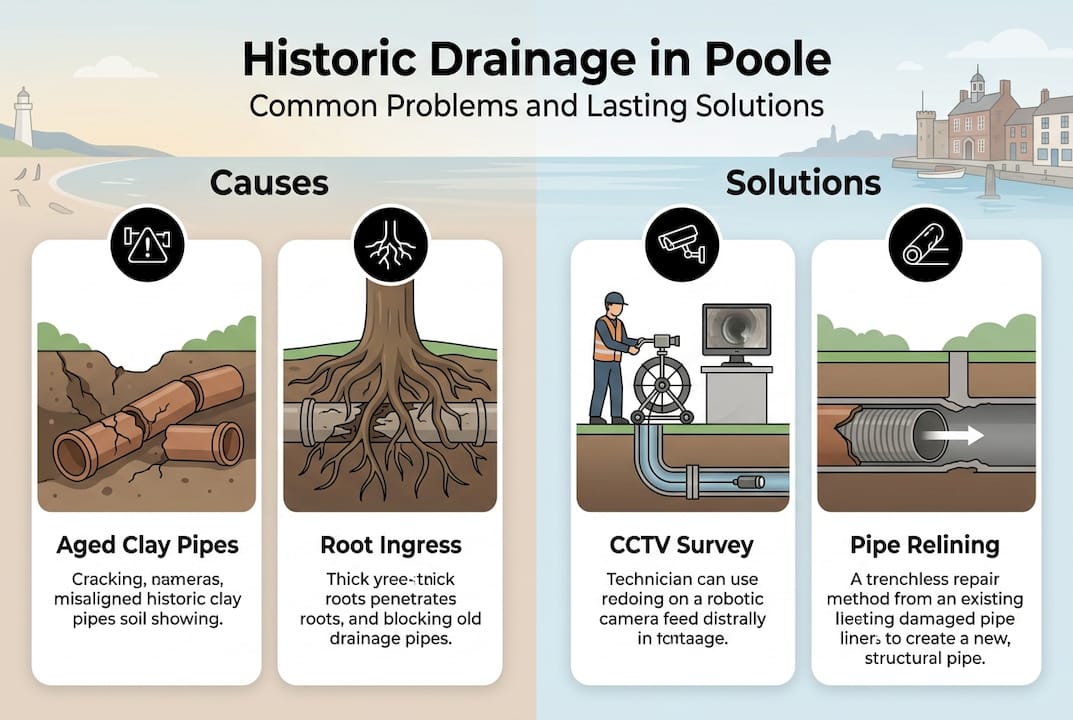
- Root ingress: Tree roots are drawn to moisture and nutrients inside drain pipes. They exploit hairline cracks in clay joints, then expand, cracking the pipe further and creating blockages.
- Collapsing clay pipes: Older clay pipes lose structural integrity over decades, particularly where ground movement has occurred near Poole’s waterfront areas.
- Grease and fat accumulation: Older, narrower pipes with rough internal surfaces trap fats far more readily than modern smooth-bore alternatives.
- Outdated drainage layouts: Many older properties have drainage routes that were designed for far lighter usage, and they simply cannot cope with modern household water volumes.
How susceptible your system is depends heavily on the age and material of your pipes. Here is a quick comparison:
| Pipe material | Typical lifespan | Common failure mode |
|---|---|---|
| Clay (Victorian era) | 50 to 100 years | Cracking, joint failure, root ingress |
| Pitch fibre (1950s to 1970s) | 40 to 50 years | Deformation, collapse |
| uPVC (modern) | 100+ years | Rare; usually joint failure only |
| Cast iron | 75 to 100 years | Corrosion, scale build-up |
The responsibility question also matters here. Public and private responsibilities differ in Poole, and the bulk of maintenance often falls on individual property owners. This means recurring problems on private drain runs are entirely the homeowner’s financial responsibility to resolve.
Knowing how to prevent drain blockages in older systems requires understanding these root causes, not just treating symptoms. And when prevention is no longer enough, modern drain repair methods offer lasting solutions that address the structural cause rather than just clearing the immediate blockage.
Restoration and modern solutions: professional approaches for lasting repair
Understanding the causes makes it far easier to appreciate why modern restoration techniques are so effective. The good news for Poole homeowners is that full pipe replacement is rarely the only option, and often not even the best one.
Here are the main professional restoration approaches used today:
- Drain relining: A resin-impregnated liner is inserted into the existing pipe and cured in place, creating a smooth, jointless new pipe within the old one. No excavation required in most cases.
- Pipe bursting: The old pipe is fractured outward while a new pipe is simultaneously pulled through. Effective for collapsed sections.
- CCTV drain surveys: A camera is passed through the drain to precisely locate and diagnose faults before any repair work begins.
- High-pressure water jetting: Clears accumulated grease, roots, and debris as a first step before structural repairs are assessed.
A typical professional restoration process follows these stages:
| Stage | What happens | Why it matters |
|---|---|---|
| Initial CCTV survey | Camera inspection of full drain run | Identifies all faults before work begins |
| Jetting and clearance | High-pressure cleaning | Prepares pipe for accurate assessment |
| Structural assessment | Engineer reviews survey footage | Determines correct repair method |
| Relining or repair | Chosen method applied | Restores structural integrity |
| Post-repair survey | Second camera inspection | Confirms repair quality |
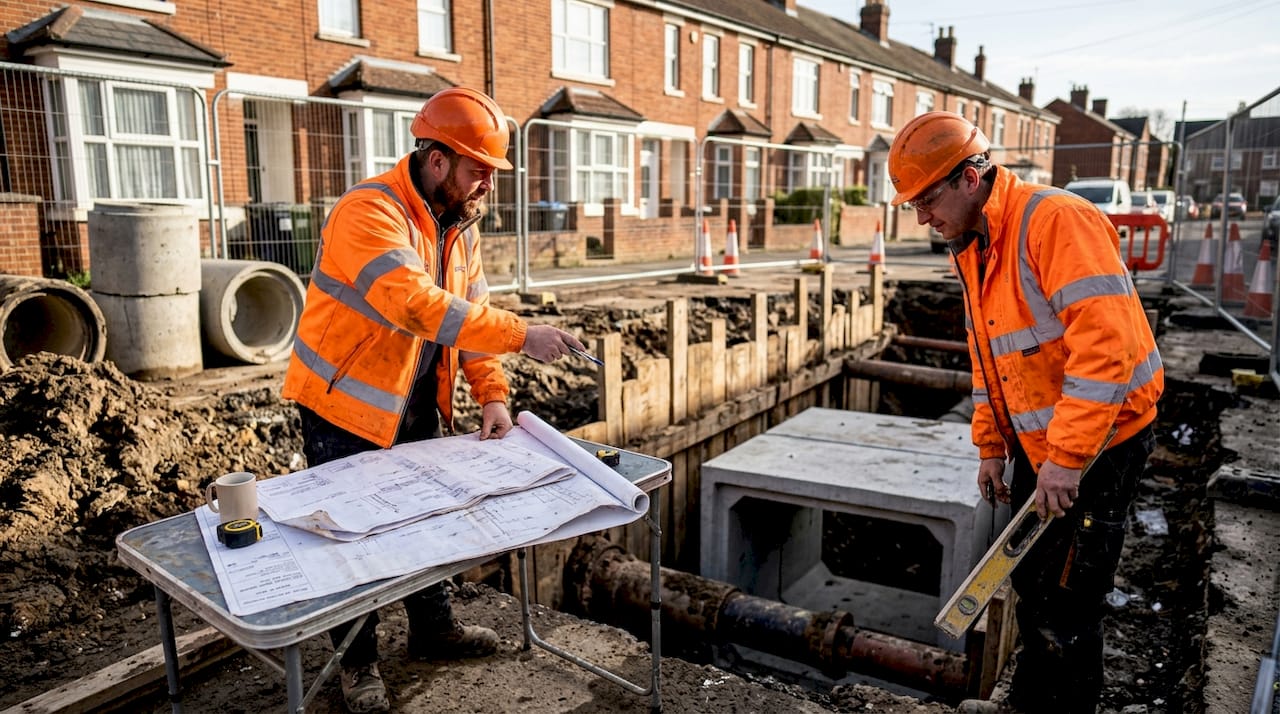
The Baiter Sluice reconstruction used precast box culverts as a modern solution to a historic infrastructure problem, demonstrating that even severely degraded systems can be restored using contemporary techniques rather than simply rebuilt from scratch.
Pro Tip: Always insist on a CCTV survey before agreeing to any repair work. A reputable contractor will welcome this step. Any firm that wants to proceed without one is guessing at the problem, and guessing is expensive.
Exploring modern drain repair methods and booking a professional drainage inspection are the two most important steps any Poole homeowner can take. If you want to understand what options exist before calling anyone, the drain repair guide offers useful background on what different repair types involve.
What most homeowners get wrong about historic drainage repairs
Here is the uncomfortable truth we see repeatedly in Poole: most homeowners wait too long, and then choose the cheapest short-term fix rather than a lasting solution. It is entirely understandable. Drainage work is disruptive, and nobody wants to spend money on something hidden underground. But this approach almost always costs more in the long run.
The second major mistake is misunderstanding responsibility. Homeowners assume the council will handle it, wait months for a response, and then discover the drain in question is entirely on private land. That delay allows a manageable problem to become a structural one.
The third mistake is relying on repeated spot repairs. Clearing a blockage is not the same as fixing the pipe that keeps blocking. If the same section of drain fails repeatedly, the pipe itself is the problem, not what went down it. Investing in modern repair methods like relining addresses the structural cause and typically pays for itself within a few years by eliminating repeated call-out costs. Smart property managers treat drainage as infrastructure investment, not just reactive maintenance.
Get professional help for historic drainage challenges in Poole
If this guide has helped you see your drainage situation more clearly, the most valuable next step is getting a professional assessment before a manageable issue becomes an emergency.

At Blocked Drains Poole, we specialise in exactly these kinds of historic drainage challenges. Our team understands the aged pipework, coastal conditions, and complex drainage layouts found across Poole’s older properties. Whether you need a drain unblocking procedure carried out urgently or want to explore drainage repair techniques for a longer-term fix, we offer upfront pricing, no call-out fees, and 24/7 availability. Do not let an ageing system become a costly emergency. Get in touch today for an expert assessment.
Frequently asked questions
Who is responsible for repairing historic drains in Poole?
Homeowners are responsible for drains within their property boundaries, while BCP Council maintains public highway gullies and shared sewers adopted by the water authority.
What are the most common signs of drainage system failure in older homes?
Frequent blockages, persistent bad smells, damp patches near drain runs, and slow water drainage are the most reliable warning signs of historic drain failure in older properties.
Can modern repair methods fix historic drainage systems without full replacement?
Yes. Techniques like relining and pipe bursting can restore aged systems with minimal disruption, as demonstrated by modern reconstruction methods used even in major public infrastructure projects in Poole.
How do I know if my drainage problem is private or council responsibility?
If the problem is within your property boundary, it is your responsibility. Issues on public roads or highways should be reported to BCP Council, who manage public highway drainage separately from private drain runs.