
TL;DR:
- Surface water drains handle rainwater from roofs, driveways, and patios separately from foul water systems.
- Proper maintenance and understanding of drainage hierarchy prevent costly flooding and structural damage.
- Regular inspections, keeping drains clear of debris, and following legal standards are essential for resilience.
Many homeowners in Poole treat all their drains as one system, assuming water simply disappears underground without consequence. This misunderstanding leads to costly blocked drain problems that could have been avoided entirely. Surface water drains are a distinct and critical part of your property’s infrastructure, handling rainwater run-off from roofs, driveways, and paved areas. Confusing them with foul water drains, or simply ignoring them, can result in flooding, structural damp, and expensive emergency call-outs. This guide covers what surface water drains are, how they protect your home, what the law requires, and how to keep them working properly year-round.
Table of Contents
- What is a surface water drain?
- How surface water drains protect your Poole property
- Legal requirements and best practices for surface water drainage
- Preventing blockages and embracing sustainable drainage
- Our perspective: why every Poole property needs a proactive drainage plan
- Need help with surface water drains? Your reliable Poole drainage experts
- Frequently asked questions
Key Takeaways
| Point | Details |
|---|---|
| Know your drains | Distinguishing between surface and foul drains prevents costly mistakes and blockages. |
| Legal compliance matters | Meeting Building Regulation standards avoids fines and protects your property sustainably. |
| Prevention beats repair | Routine checks and sustainable solutions reduce blockage risks and flooding in Poole homes. |
| Call experts when needed | Local professionals ensure your drainage system is legal, safe, and future-proof. |
What is a surface water drain?
A surface water drain collects and carries rainwater away from hard surfaces on your property. This includes water running off your roof via gutters and downpipes, water sheeting across your driveway, and run-off from patios and paths. It does not carry any waste from toilets, sinks, or washing machines. That job belongs to the foul water drain, which is a completely separate system.
The distinction matters enormously. Foul water carries bacteria and must be treated at a sewage works before it can be released safely. Surface water, by contrast, is relatively clean and can often be directed straight into the ground or a local watercourse. Mixing the two systems is not only illegal but creates serious public health risks and can overwhelm treatment facilities during heavy rain.
In a typical Poole home, you will find surface water drains in several locations:
- Gullies and grates along the edge of driveways and paths
- Downpipe connections where guttering meets the ground
- Channel drains across garage entrances or paved areas
- Soakaways buried in the garden, receiving water from downpipes
The drainage solutions for Poole homes available to you depend partly on your soil type, plot size, and proximity to watercourses. This is where the surface water disposal hierarchy becomes important. Building regulations require separate systems for foul and surface water, with a strict priority order for where surface water should go:
| Priority | Disposal method | Notes |
|---|---|---|
| 1st | Soakaway or infiltration | Preferred where ground conditions allow |
| 2nd | Watercourse | Stream, river, or ditch nearby |
| 3rd | Surface water sewer | Only if above options are not viable |
| 4th | Combined sewer | Last resort, requires approval |
This hierarchy exists because directing surface water into the public sewer network adds unnecessary pressure to the system and increases flood risk downstream. If your property has a soakaway, it should be your first port of call. Soakaways must be positioned at least 5 metres from any building and 2.5 metres from a boundary to prevent waterlogging near foundations. Pipe gradients also matter, with a minimum fall of 1:40 recommended to keep water moving and prevent sediment build-up.
Understanding where your surface water goes is the foundation of good drainage management. Many homeowners in Poole have older properties where the original drainage layout was never documented clearly, making a professional survey well worth considering.
How surface water drains protect your Poole property
A well-functioning surface water drain does something quietly impressive: it removes hundreds of litres of rainwater from your property in minutes, without you ever noticing. When it fails, you notice immediately.
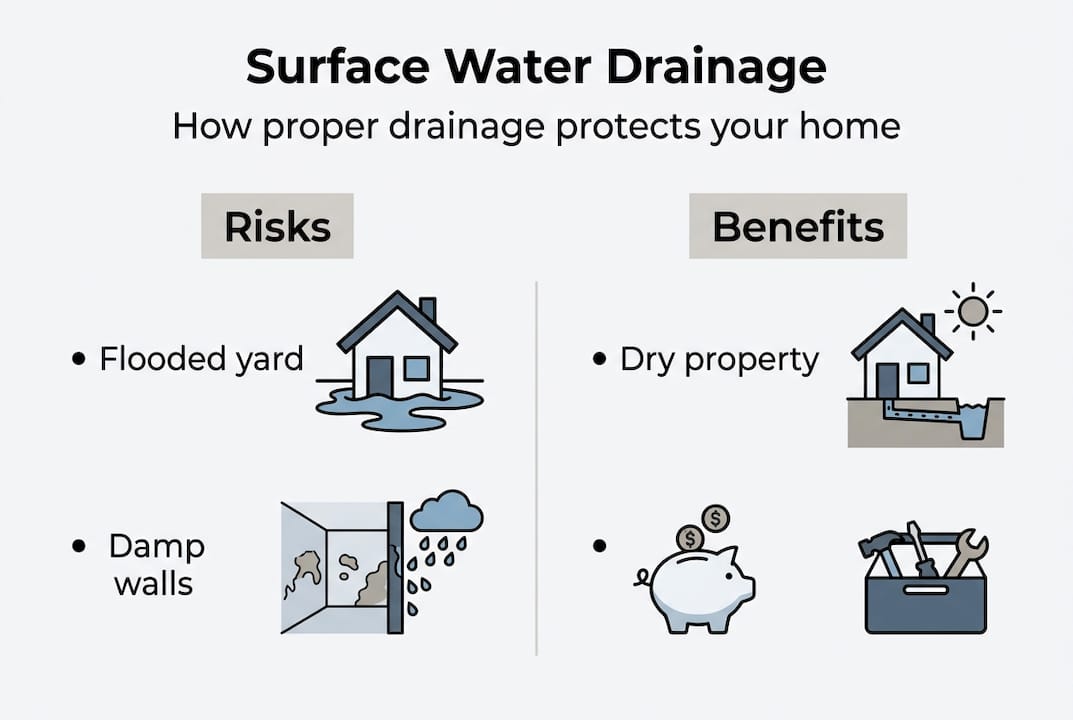
During a heavy downpour, water has nowhere to go if your surface drains are blocked or undersized. It backs up across driveways, seeps under doors, and pools against walls. Over time, persistent damp penetrates brickwork, damages foundations, and creates the conditions for mould growth inside your home. These are not minor inconveniences. They are expensive structural problems.
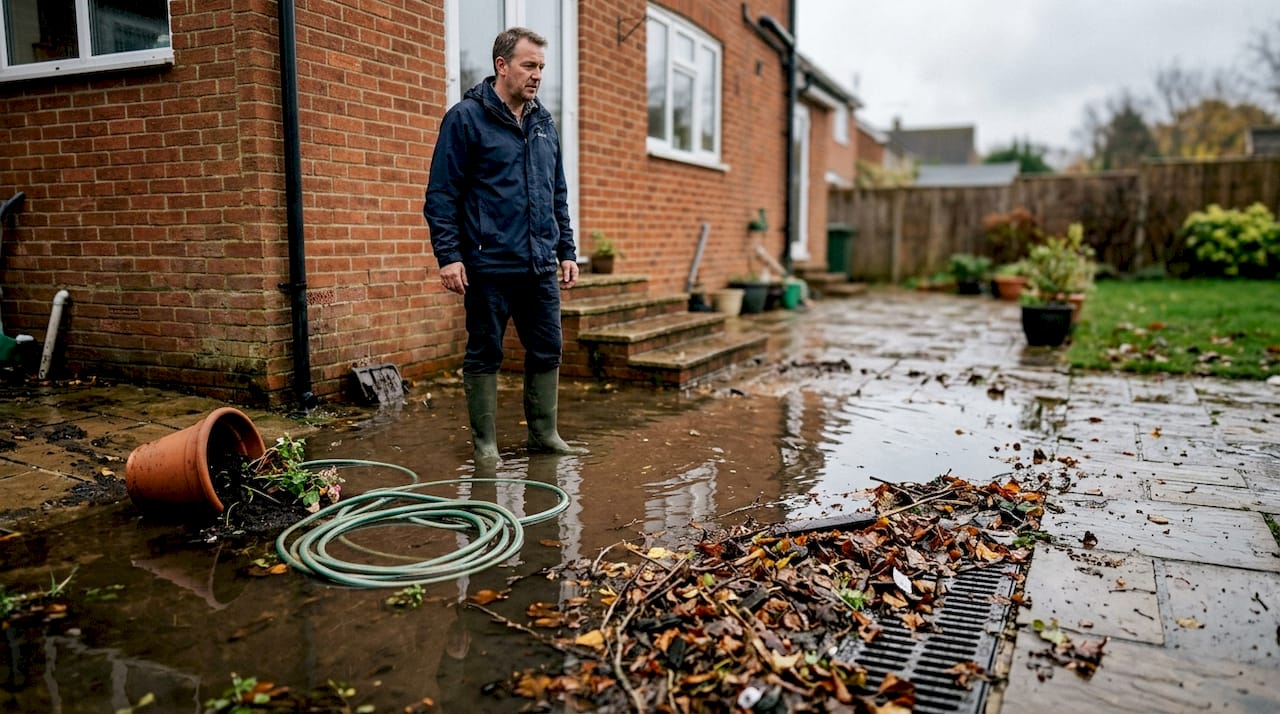
Blockages are far more common than most people realise. UK water companies handle 280,000 blockages a year at a cost of over £100 million, and surface drains are particularly vulnerable because they are open to the elements. Leaves, silt, moss, and windblown debris accumulate in gullies and channel drains constantly, especially during autumn.
| Scenario | Maintained drain | Blocked drain |
|---|---|---|
| Heavy rainfall | Water clears within minutes | Pooling and surface flooding |
| Winter freeze | Minimal risk | Ice blockages worsen damage |
| Property value | Stable or improved | Risk of survey red flags |
| Insurance claims | Less likely needed | More frequent, higher excess |
| Structural risk | Low | Elevated damp and foundation risk |
Consider a terraced property in Poole’s older residential streets. The guttering connects to a downpipe that feeds a gully at the base of the front wall. If that gully silts up over winter, every heavy shower sends water sheeting across the path and pooling against the front step. Within a season, the mortar at the base of the wall begins to deteriorate. The homeowner notices a damp patch inside. By the time a builder investigates, the repair bill runs to thousands of pounds, all traceable to a blocked gully that could have been cleared for very little.
This is why flooding from blocked drains is taken so seriously by local drainage professionals. The damage is rarely dramatic and sudden. It is slow, cumulative, and expensive. Identifying drainage issues in Poole homes early is always cheaper than dealing with the consequences later.
The most expensive drain problem is the one you didn’t see coming. Regular checks cost almost nothing. Emergency repairs rarely do.
Legal requirements and best practices for surface water drainage
Understanding the risks makes the legal framework easier to appreciate. The rules are not bureaucratic box-ticking. They exist because poorly managed surface water affects not just your property but your neighbours and the wider drainage network.
Approved Document H sets separation requirements for drainage systems, including the disposal hierarchy, soakaway distances, and pipe gradients. These apply to new builds and to any modifications you make to existing drainage. If you are adding a driveway, extending your home, or installing a new downpipe connection, you are likely triggering a compliance requirement.
Here is a practical checklist for verifying your drainage meets legal requirements:
- Confirm separation. Check that your surface water and foul water drains connect to separate systems. A CCTV survey is the most reliable way to confirm this.
- Locate your soakaway. If you have one, check it is at least 5 metres from your building and 2.5 metres from your boundary.
- Check pipe gradients. Pipes should fall at a minimum of 1:40 to avoid standing water and sediment accumulation.
- Review ownership. Private drains within your boundary are your responsibility. Shared drains serving multiple properties may have been transferred to Wessex Water under the 2011 regulations.
- Inspect regularly. Gullies, channel drains, and soakaways should be checked at least twice a year.
A drainage inspection in Dorset carried out by a qualified professional can map your system and flag any compliance gaps before they become enforcement issues or insurance complications.
Pro Tip: Contact Wessex Water directly to request a copy of the drainage map for your area. This will show which drains are publicly adopted and which remain private. It is a free service and can save significant confusion when buying, selling, or modifying a property.
One frequently overlooked point: building regulations set minimum standards, not ideal ones. A drain that technically meets the minimum gradient may still perform poorly in a Poole storm if it is undersized for the catchment area it serves. Regulations are a floor, not a ceiling.
Preventing blockages and embracing sustainable drainage
The most effective drainage strategy is one that prevents problems rather than reacts to them. Surface water drains are especially prone to blockage because they are exposed to everything the weather and your garden can throw at them.
Leaves are the most obvious culprit, particularly in autumn. But silt, moss, algae, and fine debris from gravel driveways also accumulate steadily. Over months, a gully that drains freely in spring can be almost completely blocked by November. The fix is straightforward: regular clearing. The discipline to do it consistently is what most homeowners lack.
Here is a practical maintenance routine to keep your surface water drains working properly:
- Weekly (autumn months): Clear leaves and debris from gully grates and channel drain covers
- Monthly: Pour a bucket of water into each gully to check it drains freely
- Twice yearly: Lift gully pots and remove accumulated silt from the base
- Annually: Inspect downpipe connections and soakaway inspection chambers if accessible
- After storms: Walk the property perimeter and check for pooling or slow drainage
To prevent drain blockages effectively, you also need to think about what enters the system. Never sweep garden waste into gullies. Avoid using gravel near surface drains without a proper edging barrier. Keep gutters clean so downpipes do not overflow and deposit debris at ground level.
Beyond maintenance, sustainable drainage systems like permeable paving and rain gardens are increasingly recommended for new and retrofit properties to reduce flood risk. Permeable block paving on a driveway, for example, allows rainwater to filter through the surface and into the ground rather than running off into a drain. A rain garden, planted in a shallow depression, captures run-off and allows it to soak away naturally while adding greenery to your garden.
These approaches reduce the volume of water entering the drainage system during storms, which lowers flood risk for your property and for the wider area. They also tend to require less maintenance than traditional piped drainage. For drain maintenance steps and information on modern drainage repair methods, local specialists can advise on what suits your property type and budget.
Pro Tip: The most overlooked maintenance task is clearing the silt pot inside a gully. The grate on top catches large debris, but fine silt settles in the pot below and is invisible until the drain backs up. Lift the grate, scoop out the pot, and you will be amazed at what accumulates in a single season.
Our perspective: why every Poole property needs a proactive drainage plan
After years of working on drainage systems across Poole and Dorset, one thing stands out clearly: almost every serious drainage problem we encounter was avoidable. Not difficult to avoid. Simply avoidable, with a basic plan and a little routine attention.
The regulations around surface water drainage set a minimum. They tell you what you must not do and what you must achieve. They do not tell you what good drainage actually looks like in practice for a 1930s semi-detached in Canford Heath or a modern flat-roofed extension in Branksome. That gap between the minimum and the genuinely resilient is where most problems live.
We see homeowners who have technically compliant drainage that still floods every winter because the soakaway is too small for the roof area it serves. We see properties where the risks of blocked drains were dismissed until a storm caused thousands of pounds of damage. Compliance is not the same as protection.
A proactive drainage plan means knowing your system, maintaining it seasonally, and investing in improvements before problems force your hand. Properties with well-documented, well-maintained drainage are easier to sell, cheaper to insure, and simply more resilient. That is not a sales pitch. It is the pattern we observe consistently across the properties we work on.
Need help with surface water drains? Your reliable Poole drainage experts
If reading this has made you realise you are not entirely sure where your surface water goes or when your drains were last checked, that is a very common position to be in.

At Blocked Drains Poole, we carry out thorough surveys, unblocking, and repairs for surface water drainage systems across Poole and the surrounding Dorset area. Whether you need to understand the drain unblocking procedure for a blocked gully or want a full drainage inspection checklist completed by a local specialist, we are ready to help. We offer upfront pricing, no call-out fees, and 24/7 availability. Explore the role of drainage inspection and get in touch today to book your survey or request emergency assistance.
Frequently asked questions
How can I tell if my property’s drains are for surface water or foul water?
Look for grates and gullies outside on driveways and paths, which typically indicate surface water drains. Systems must be separate and mapped, so your local water provider can confirm ownership and routing if you are unsure.
What are the signs of a blocked surface water drain?
Pooling water after rainfall, slow-draining gullies, and unpleasant smells near external drains are the clearest indicators. Blocked surface drains cause localised flooding and odour issues that tend to worsen with each heavy shower.
Are surface water drains in Poole my responsibility?
Drains within your property boundary are generally your responsibility to maintain. Shared drains became public after the 2011 transfer, so anything serving multiple properties is likely managed by Wessex Water, which you can verify using their drainage maps.
Do I need permission to change the surface water drainage at my home?
Yes. Any modifications must comply with Building Regulations Approved Document H and may require approval from your local council or Wessex Water. Building regs mandate compliance for all new and modified drainage connections, including changes to soakaways and downpipe routing.